
Introduction
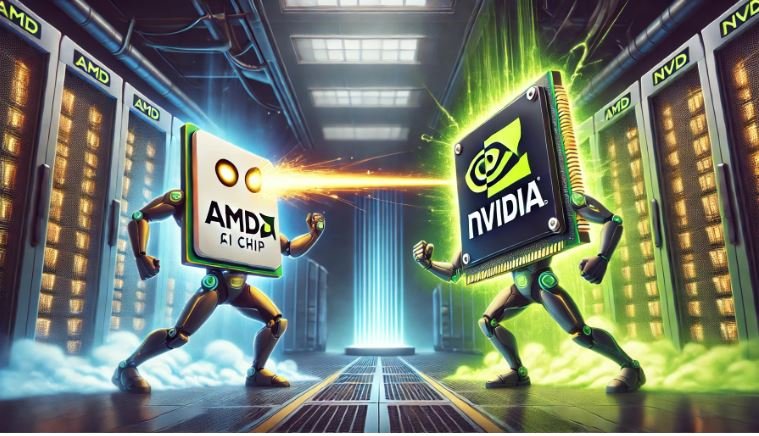
The year is 2025, and the battle for the semiconductor market is fiercer than ever, with the main competitors being NVIDIA and AMD. As the world continues to evolve in AI, gaming, data centers, and the adoption of next-generation technologies, both corporations are experiencing many changes in their market positions. Here are the current sales trends and what is behind each company’s growth in the chip market.
Contents
NVIDIA: The Dominant Force in AI and Graphics
Gaming Graphics Cards NVIDIA and AMD
NVIDIA is still the leader in the high-end gaming market. NVIDIA’s GPUs are a favorite among enthusiasts and video creators for their performance, and the GeForce RTX 40-series includes the RTX 4090 and RTX 4080. With ray tracing and DLSS (a super-sampling technology based on deep learning), NVIDIA continues to dominate the gaming industry.
- Sales Growth: Sales of the gaming GPUs in the NVIDIA have registered robust year-on-year growth, especially in high-end graphics cards, on the back of next-generation games and the use of VR/AR.
Data Center and AI Chips
Perhaps NVIDIA’s most profitable division is AI and data centers. NVIDIA offers its A100 and H100 Tensor Core (+) chips, and in this way they have established themselves as a one-stop provider of AI infrastructure that handles machine learning, autonomous vehicles, and cloud computing services. As more and more companies integrate AI, the demand for the company’s chips is increasing.
- Q2 2025 Earnings: Based on the most recent financial results, the data center business of NVIDIA has experienced an increment of 20 percent in sales, and AI and machine-learning developments are the contributors of the growth.
Autonomous Vehicles
The market for autonomous driving is also expanding, and NVIDIA is playing a key role with its Drive AGX platform. While it remains a niche market, the long-term prospects are promising, especially with increasing investment in autonomous driving technology.
READ MY ANOTHER POST:Google Pixel 10 Pro| 5 Shocking Features You Need to Know!
AMD: Gaining Ground with Aggressive Innovation
Gaming Graphics Cards
When it comes to GPU manufacturing, AMD has always been considered a rival to NVIDIA, and with its Radeon RX 7000 family, it’s clear that the company is making impressive progress. The RDNA 3 architecture has allowed AMD to maintain a competitive GPU price that is high throughput.
- Sales Surge:The Radeon RX 7000 series should reach to a maximum of 30 percent of GPU market share through the year 2025 as opposed to the annual market share of previous years. The increase is accredited to the price-performance products created by AMD that have become popular in the middle-level gaming and enthusiasts.
CPUs: Ryzen and EPYC Leading the Charge
In the CPU market, AMD has followed up its previous success with the introduction of the Ryzen 7000 series of desktop processors, which can compete with Intel products in the market. Consumer and enterprise customers are excited about the launch of the Zen 4 architecture and rumors about the Zen 5 chips.
- Enterprise Growth: AMD is taking off in the server space: a variety of big cloud providers have chosen AMD processors, particularly its EPYC line, instead of Intel in their server parks. The change has been a major factor in the expansion of AMD as it saw an increase of 15% in server sales in Q2 2025.
NVIDIA and AMD: A Battle for AI
While NVIDIA is well positioned in AI chips with its A100 and H100, AMD has not been idle. It has also expanded its own offerings along with other product improvements, such as AI-specific accelerators in its Instinct GPU products. However, AMD remains inferior in all AI infrastructures, in contrast to NVIDIA’s dominance in the market.
Market Trends in 2025: Who’s Winning?
The landscape for NVIDIA and AMD is evolving rapidly, with both companies showing impressive growth in different segments:
- AI and Data Centers: NVIDIA is already the leader in this area with 40 percent market share in the sales of AI hardware. This comes courtesy of its CUDA cores, Tensor cores and custom such as the H100.
- Gaming GPUs: NVIDIA can continue to dominate the high-end power with AMD gaining a great deal of ground on the mid-range and low-end gaming groups.
- CPUs: AMD is gradually replacing Intel, and its Ryzen and EPYC processors are gaining more and more popularity both among consumers and in the enterprise.
The Geopolitical Impact
Chip shortages and geopolitical issues have played a major role in the development of both companies. Production constraints have existed due to export restrictions and supply chain disruptions, and both NVIDIA and AMD have taken steps to respond to these constraints by expanding production capacity and diversifying their supply chains.
Conclusion
As we move further into 2025, NVIDIA and AMD will continue to challenge each other in various chip markets, with each company emerging as the champion in a specific market. NVIDIA is dominating the AI market and the high-performance GPU market, while AMD is closing its gap in the gaming GPU market and making big leaps in the CPU and server markets. With more innovation and disruption expected in the next few years, these two companies are testing the limits of their potential in the semiconductor market.
1 thought on “NVIDIA and AMD: 2025 Chip best Sales Trends and Market Dominance”
Comments are closed.